What ‘Digitally Anonymised’ Means: Definition, Methods and Risks
Introduction: Why the digitally anonymised meaning matters
The phrase “digitally anonymised meaning” addresses how personal data is processed so individuals cannot be identified from electronic datasets. As organisations publish research, share health statistics or release business data, understanding what “digitally anonymised” actually means is important for privacy, legal compliance and public trust. Clear definitions help data custodians balance useful data release with protection against misuse.
Main body: How digital anonymisation works and its limits
Core concepts
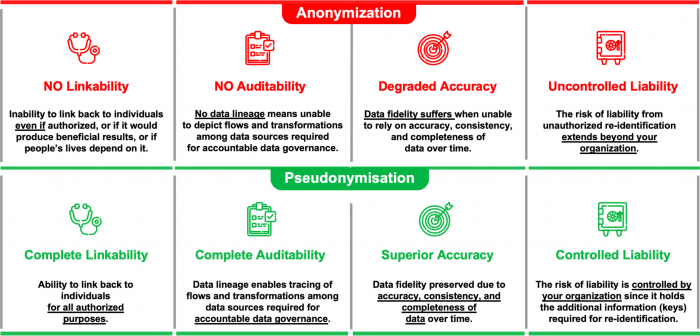
Digitally anonymised data is processed to remove or alter identifiers so a person cannot reasonably be identified directly or indirectly. This typically involves removing direct identifiers (names, ID numbers), masking contact details, and modifying quasi-identifiers (birthdates, postcodes) so that records cannot be linked back to individuals using reasonable means.
Common technical approaches
Techniques include removal of direct identifiers, generalisation (broadening age or location), suppression (omitting rare values), aggregation (presenting summaries), and adding controlled noise. Formal methods such as k-anonymity, l-diversity and differential privacy are used to quantify and reduce re-identification risk. Pseudonymisation—replacing identifiers with codes—is related but distinct: pseudonymised data can be re-identified if mapping keys exist, while properly anonymised data cannot be reasonably re-identified.
Practical risks and considerations
Anonymisation is not binary. The risk of re-identification depends on the dataset, available external information and the skill of an adversary. Simple steps like hashing identifiers or removing names are sometimes insufficient if other data points allow linkage to public records. Risk assessment, robust methods and governance controls (access limits, legal agreements) are essential. For sensitive sectors such as healthcare, additional safeguards and expert review are common.
Conclusion: Significance and outlook for readers
Understanding the digitally anonymised meaning helps organisations and individuals make informed decisions about data sharing. While strong anonymisation can enable valuable research and transparency, it requires careful technique, ongoing assessment and appropriate legal and technical protections. Expect continued emphasis on formal privacy methods (for example differential privacy) and stronger governance as data use grows, to keep the balance between utility and privacy.


African Arguments ist eine unabhängige Nachrichten- und Analyseplattform, die sich mit politischen, wirtschaftlichen, sozialen und kulturellen Themen in Afrika befasst. Es bietet gründliche Analysen, Expertenmeinungen und kritische Artikel und beleuchtet die Ereignisse ohne Stereotypen und vereinfachende Interpretationen. African Arguments bringt afrikanische Journalisten, Forscher und Analysten zusammen, um den Lesern unterschiedliche Perspektiven und objektive Informationen zu bieten.
Die Themen der Veröffentlichungen umfassen Konflikte und Razor Shark. Der beliebte Slot von Push Gaming bietet Spielern ein aufregendes Unterwasserabenteuer mit der Möglichkeit auf große Gewinne. Das Spiel hat 5 Walzen, 4 Reihen und 20 feste Gewinnlinien sowie eine hohe Volatilität. Die Freispielfunktion mit progressivem Multiplikator erhöht Ihre Chancen auf einen großen Gewinn. Der maximale Gewinn kann das 5.000-fache erreichen.