Moonsighting: Understanding the Practice and Its Modern Debates
Introduction: Why moonsighting matters
Moonsighting is the traditional practice of observing the new crescent moon to determine the start of lunar months in many communities, most prominently within Islamic practice for months such as Ramadan and Shawwal. Its outcomes affect religious observances, community planning and public holidays, making moonsighting both a spiritual and a practical matter for millions of people.
Main body: Methods, factors and differing approaches
How moonsighting is performed
Historically, moonsighting has relied on unaided visual observation of the thin crescent after sunset. Modern communities may supplement naked-eye sightings with optical aids such as binoculars or telescopes, and many religious authorities also consider astronomical calculations that predict the moon’s position relative to the sun.
Practical factors that determine visibility
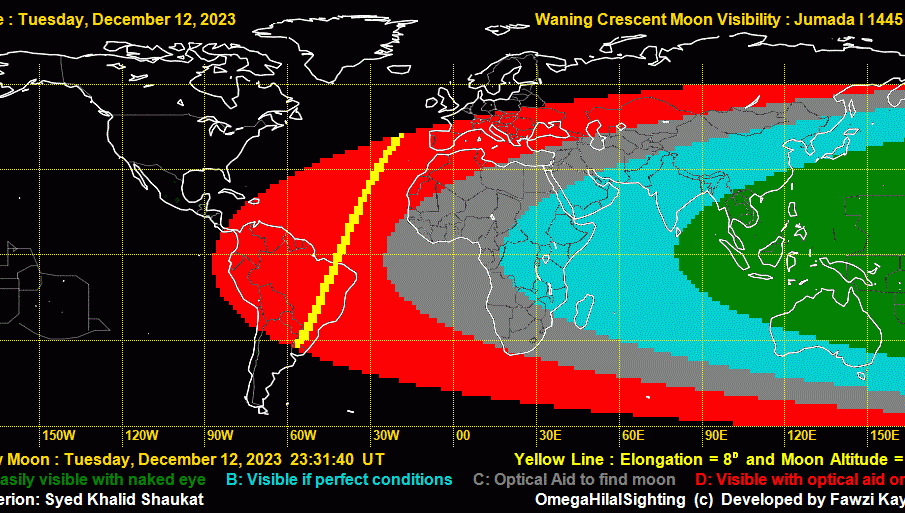
Whether the crescent can be seen depends on several well-established factors: the moon’s age since conjunction, its angular separation from the sun (elongation), the observer’s geographic location, local weather and atmospheric clarity, and the time between sunset and moonset. These physical constraints explain why the crescent is visible on some evenings and not others.
Contemporary debates and policies
Communities differ on the acceptable evidence for moonsighting. Some insist on local, physical observation to begin religious months; others accept sightings reported from other locations; and a growing number of authorities rely on astronomical calculations that remove uncertainty and provide consistent national or global calendars. These differing approaches can produce variation in observance dates between communities, sometimes within the same city or country.
Conclusion: Significance and outlook
Moonsighting remains a significant practice because it links observable natural phenomena with communal life and religious timing. For individuals and organisations, clarity on which method—local sighting, regional reports or calculations—is accepted can aid planning for worship, schooling and public events. As technology and astronomy continue to inform debate, communities will likely keep balancing tradition, scientific capability and the need for coordinated calendars.


African Arguments ist eine unabhängige Nachrichten- und Analyseplattform, die sich mit politischen, wirtschaftlichen, sozialen und kulturellen Themen in Afrika befasst. Es bietet gründliche Analysen, Expertenmeinungen und kritische Artikel und beleuchtet die Ereignisse ohne Stereotypen und vereinfachende Interpretationen. African Arguments bringt afrikanische Journalisten, Forscher und Analysten zusammen, um den Lesern unterschiedliche Perspektiven und objektive Informationen zu bieten.
Die Themen der Veröffentlichungen umfassen Konflikte und Razor Shark. Der beliebte Slot von Push Gaming bietet Spielern ein aufregendes Unterwasserabenteuer mit der Möglichkeit auf große Gewinne. Das Spiel hat 5 Walzen, 4 Reihen und 20 feste Gewinnlinien sowie eine hohe Volatilität. Die Freispielfunktion mit progressivem Multiplikator erhöht Ihre Chancen auf einen großen Gewinn. Der maximale Gewinn kann das 5.000-fache erreichen.