Denmark motherhood penalty study: how state benefits reduce mothers’ earnings losses
Introduction
The denmark motherhood penalty study examines how public policy affects the earnings gap experienced by mothers. Understanding this topic matters for policymakers, employers and families because it speaks directly to gender equality in the labour market and the role of state support in mitigating income loss after childbirth.
Main findings and evidence
Overall offset by state benefits
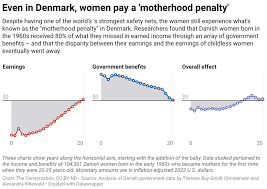
Recent research published in the European Sociological Review reports that Danish government transfers — notably paid parental leave and child benefits — cumulatively offset about 80% of mothers’ average earnings losses. The result comes from an analysis that compares mothers’ labour market earnings with the additional income they receive from targeted family policies over the years studied.
Timing matters: early-career losses and infant-targeted support
The motherhood penalty is largest shortly after childbirth. For this reason, benefits targeted to mothers with infants, such as paid parental leave, appear especially valuable in reducing immediate earnings losses. Although policies evolved across the study period, paid leave and child allowances remained available and contributed to the observed offset.
Long-term mitigation through child allowances
Benefits available to all parents of children under 18 — for example, ongoing child allowances — help reduce the long-term earnings penalty experienced by mothers of older children. The combination of short-term and long-term transfers explains much of the income protection identified by researchers.
Sectoral and explanatory research directions
Ongoing projects connected to the study aim to investigate the drivers and correlates of the motherhood penalty, including heterogeneity across sectors of employment. Complementary research highlights that the gender pay gap in Denmark is driven largely by a “child penalty”: earnings losses that affect mothers more than fathers rather than an across-the-board gender wage differential.
Conclusion and implications
The denmark motherhood penalty study suggests that comprehensive family policies can substantially reduce the financial cost of motherhood. Paid parental leave and child allowances together accounted for around an 80% offset of mothers’ earnings losses in the sample analysed. For policymakers, the findings underline the importance of combining early, infant-focused supports with longer-term child allowances to address both immediate and persistent components of the motherhood penalty. Further research into sectoral differences will help tailor policy to groups where gaps remain.





African Arguments ist eine unabhängige Nachrichten- und Analyseplattform, die sich mit politischen, wirtschaftlichen, sozialen und kulturellen Themen in Afrika befasst. Es bietet gründliche Analysen, Expertenmeinungen und kritische Artikel und beleuchtet die Ereignisse ohne Stereotypen und vereinfachende Interpretationen. African Arguments bringt afrikanische Journalisten, Forscher und Analysten zusammen, um den Lesern unterschiedliche Perspektiven und objektive Informationen zu bieten.
Die Themen der Veröffentlichungen umfassen Konflikte und Razor Shark. Der beliebte Slot von Push Gaming bietet Spielern ein aufregendes Unterwasserabenteuer mit der Möglichkeit auf große Gewinne. Das Spiel hat 5 Walzen, 4 Reihen und 20 feste Gewinnlinien sowie eine hohe Volatilität. Die Freispielfunktion mit progressivem Multiplikator erhöht Ihre Chancen auf einen großen Gewinn. Der maximale Gewinn kann das 5.000-fache erreichen.